Sunday, December 6, 2009

Log: (09-29-2009 - 11-25-2009)

25 November 2009 (L+195, DOY 329)

The findings of the HIFI investigation team and the proposed plan for bringing HIFI back in operation were presented to the ESA Director of Science and Robotic Exploration and others in a briefing meeting held in ESTEC on 25 November 2009. The plan presented was endorsed, and is now the adopted way forward.

[G. Pilbratt, Herschel Project Scientist, posted 27 November 2009]


19 November 2009 (L+189, DOY 323)

The plan for bringing HIFI back in operation is now on the table, and subject to formal approval in the coming week. The plan consists of performing a number of software updates in the coming weeks, followed by a full instrument switch-on in January 2010, after which HIFI operations will resume. See information provided on the SRON website.

[G. Pilbratt, Herschel Project Scientist, posted 20 November 2009]


26 October 2009 (L+165, DOY 299)

The HIFI failure investigation team set-up at ESA in support of the Principal Investigator effort in SRON is finalising its work and a draft report is currently under review within the team. The content of this report will be presented to the ESA Director General and the Director of Science and Robotic Exploration this week. Due to the capability to perform extended tests on fully representative hardware and software on the ground, and to the excellent cooperation between the PI team and ESA specialists, the investigation has arrived at a complete and consistent failure scenario which can explain the observable evidence. Some further consolidating investigations on this scenario are still on-going but the picture that has emerged is the following:

A Single Event Upset (SEU) in the Random Access Memory (RAM) of the Local Oscillator Control Unit (LCU) microcontroller would be at the origin of a chain reaction that eventually results in an unplanned emergency switch off of sensitive instrument components. Designed to protect the local oscillators against damage from undervoltage on the spacecraft 28 V bus, this switch was thrown while the 28 V bus was alive. The resulting load transient in the internal power system of the LCU associated with this mode change created a stress in the power converters, leading to a permanent failure of one of the diodes.

Before the restart of the instrument on the redundant signal chain can be performed, changes in the operation and protection logic of the instrument must be implemented and validated in on-board software to prevent re-occurrence of such a sequence of events.

Although the detailed investigations have uncovered some marginalities in the stress applied to certain diodes in the internal power system of the LCU, laboratory tests have shown these diodes to be quite resilient against the short overvoltage spikes they are subjected to during nominal instrument operations. The investigation team is confident that HIFI can perform nominally for the remainder of the mission if the required corrective actions are implemented.

[J. Riedinger, Herschel Mission Manager and co-chair of the ESA investigation team]


5 October 2009 (L+144, DOY 278)

Progress towards re-enabling HIFI

Today, SRON have added an entry to their top level web page (www.sron.nl), in which they report about the progress that is being made towards re-enabling HIFI operations. Despite the progress which is undoubtedly made by the joint HIFI/ESA investigation team, the HIFI Project Manager cautions that switching the instrument back on may still be a few weeks in the future: We must ensure that we have taken all conceivable measures to minimise the risk of such a chain of events from happening again. One of these measures may require changes in on-board software, the validation of which would have to be performed with the utmost care.

[J. Riedinger, Herschel Mission Manager]


29 September 2009 (L+138, DOY 272)

First science data distributed to the users community

Yesterday 28 September Herschel reached another important milestone: the first set of observations corresponding to the so-called 'Science Demonstration Phase" were made available to their owners. This delivery took place several weeks ahead of the originally planned schedule and marks the start of the transition from the Performance Verification Phase to the Routine Phase of operations.

The observations (six so far only) were conducted on 12 September 2009 and successfully processed with the latest version of the pipeline as implemented in a dedicated version of HIPE that was also distributed to the observers. They are SPIRE scan maps of a variety of astronomical sources including a galactic HII region, a proto-planetary nebula, a supernova remnant, and a couple of galaxy clusters. This is the first of the observing modes released to the users community following its early validation during the Performance Verification Phase.

If there are no major contingencies, we expect to be running the Science Demonstration Phase at full speed during the second half of October and the whole month of November, as initially planned, first with PACS and SPIRE AORs, and then with HIFI as well, once the instrument resumes operations and completes its own performance and verification phase, delayed because of the problems already reported in this (B)log.

[P. Garcia-Lario, HSC ESAC, posted 30 September 2009]

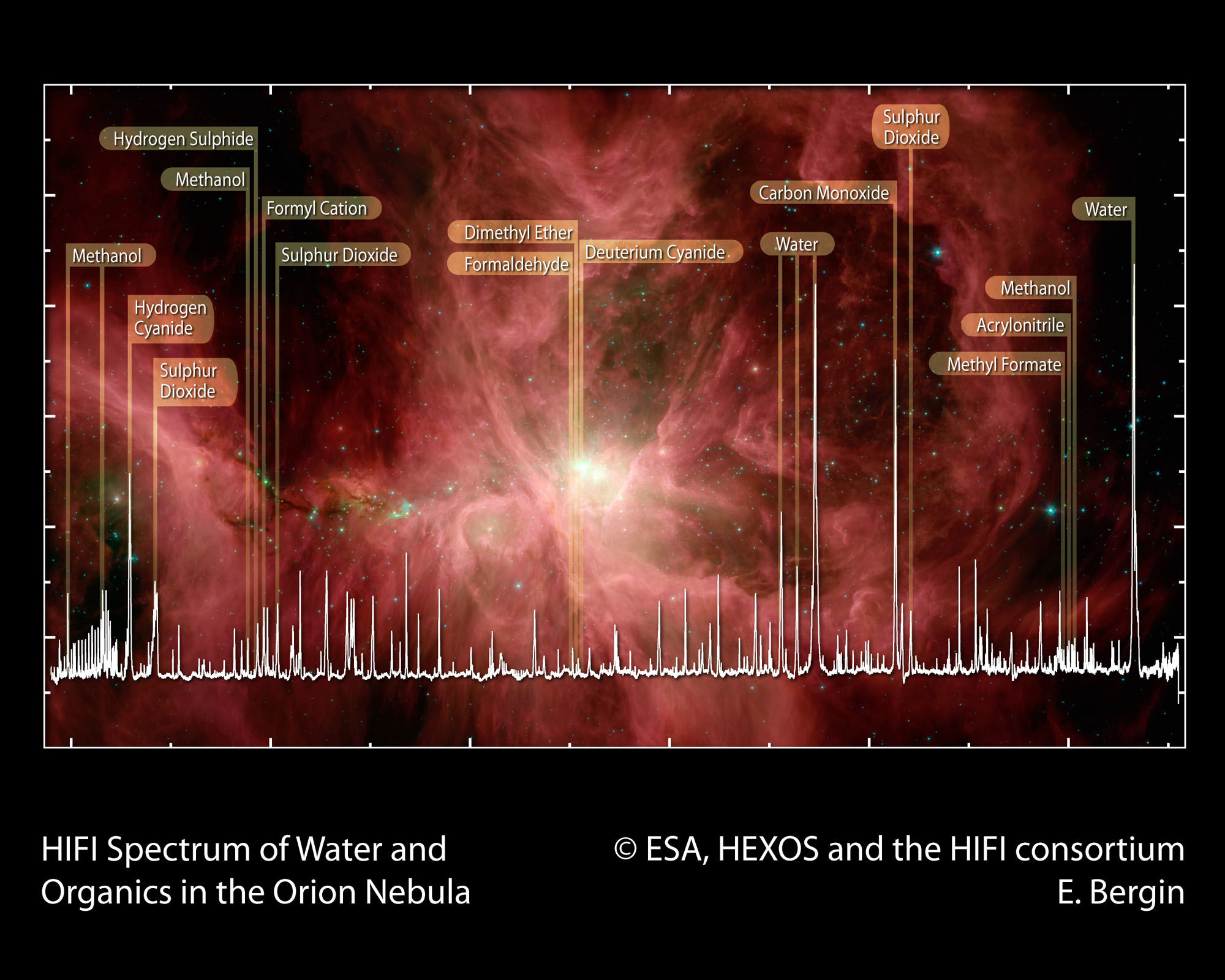
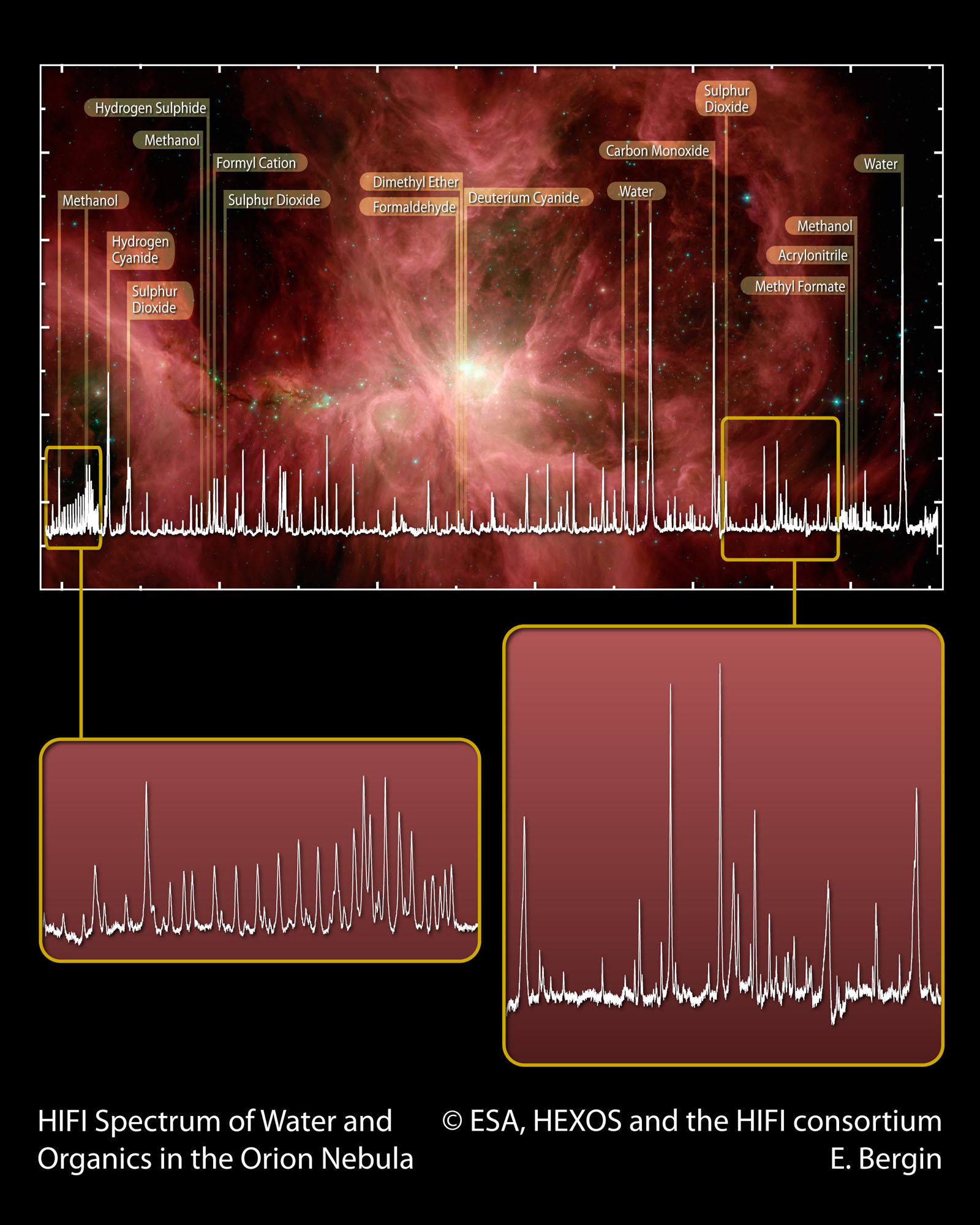
First look at Herschel Spectroscopy

ESA put out a major release today showing the first results from the spectrographs on Herschel. The release includes data on the Orion star formation region, on nearby and distant galaxies, on a massive star about to become a supernova and on a comet in our own solar system. The latter set of data was taken with HIFI before the technical fault that has left it shut down, awaiting a restart early next year.

These spectroscopic observations show the huge potential of Herschel to show us the physical and chemical processes going on inside dusty objects, be they star formation regions in our own galaxy, or in luminous interacting galaxies like Arp220 and Mrk231. My own research interests are more focussed on the distant luminous objects, and the data shown here from two archetypical ULIRGs (Ultraluminous Infrared Galaxies) are really spectacular. Never before have we seen the rich range of spectral lines that PACS and SPIRE have revealed in these objects.

PACS also holds out the hope of examining the velocity structure of some of these lines. This is particularly interesting in Mrk231 which hosts not only a massive burst of star formation but also a supermassive black hole powering a hugely luminous active galactic nucleus (AGN). The relationship between galaxy interactions and mergers in triggering both starbursts and AGNs is a hot topic, and Mrk231 makes an ideal testbed.

Finally, for sheer spectral richness and complexity, the PACS spectrum of the massive star VYCMa takes some beating. There’s a huge amount of physics and chemistry in this spectrum of a star deep into its old age and soon to become a supernova. Unfortunately this isn’t my area, so hopefully someone will add comments describing what the data means for this object.

For more information and coverage of these results see the ESA web release, BBC News Online, and the SPIRE website at Cardiff University.

Wednesday, September 16, 2009

Log: (06-19-2009 - 09-11-2009)

11 September 2009 (L+120, DOY 254)

Update on the HIFI anomaly investigation

On Monday this week, the team established by ESA to investigate into the HIFI anomaly together with SRON met with instrument experts in Groningen for an extended question and answer session. Over the coming weeks the ESA team will help HIFI in trying to piece together what appears to be a complex puzzle of events which includes, but seems to be more complex than, failure of a DC/DC converter. By correctly understanding the failure scenario we hope to be able to minimise the risk when we switch HIFI back on, possibly using its redundant signal chain.

[J. Riedinger, Mission Manager and co-chair of the ESA investigation team]


4 September 2009 (L+113, DOY 247)

An update regarding the ongoing HIFI LCU malfunction investigation activities has today been posted on the ESA Corporate website.

The bottom line is that the investigation effort underway in SRON since the problem occurred is being augmented by an ESA team. The common objective is to determine the chain of events leading to the malfunction, and to decide when and under what conditions it can be considered safe to continue HIFI operations using the redundant set of warm electronics units.

[G. Pilbratt from ESTEC, posted 4 September 2009]


14 August 2009 (L+92, DOY 226)

Statement regarding HIFI LCU malfunction

On 3 August 2009 it was discovered by HIFI that on the day before the local oscillator control unit (LCU) had developed an anomaly leading to HIFI shutting down. Since then the HIFI consortium has been intensely investigating the nature of the problem; today the HIFI Principal Investigator Frank Helmich has provided the following statement:

"During normal check-out observations HIFI was shut down due to an unknown event in the analog voltage supply unit of the control electronics of the HIFI Local Oscillator. Engineers and scientists from the HIFI Instrument Control Centre and the hardware institutes are working to determine the cause and resume HIFI observations. An ongoing analysis suggests that there was either an upset in the power supply unit itself, or a voltage drop of the central unit supplying power to it. The power supply unit is needed for the instrument to obtain science observations. HIFI does have a duplicate, or redundant, set of electronics that will be used and which provides full functionality. The engineering and science team is working to understand the cause of the anomaly before switching to the duplicate set of electronics."

[G. Pilbratt from IAU GA in Rio de Janeiro, posted 14 August 2009]


10 July 2009 (L+57, DOY 191)

Herschel 'First Light' observations

You can now have a look at the 'first-light' observations released today, including SPIRE imaging of the nearby galaxies M66 and M74, HIFI spectroscopy of the star-forming region DR21, and PACS imaging spectroscopy of the planetary nebula NGC 6543.

The beauty and quality of these very first test observations is encouraging and demonstrates that a lot of new discoveries and exciting science is ahead of us! Follow Herschel progress also on the 'Latest News' page.

[P. Garcia-Lario, HSC ESAC, posted 10 July 2009]

7 July 2009 (L+54, DOY 188)

'First Light' web release this friday

A collection of 'First Light' images and spectra taken by the three instruments onboard Herschel during the days following the cryo-cover opening will be publicly made available this Friday 10 July. Watch out for the accompanying set of coordinated web releases by ESA and the different ICC consortia!

[P. Garcia-Lario, HSC ESAC, posted 7 July 2009]


3 July 2009 (L+50, DOY 184)

The coldest place in the outer space is no longer Herschel

Last night, the detectors of Planck's HFI (High Frequency Instrument) reached a temperature of 100 mK, making them the coldest thing in space, surpassing the record established by SPIRE detectors, which are operating at a warmer temperature of only 280 mK. After a successful orbit insertion maneouvre started at 13:15 CEST yesterday, Planck has now entered its final orbit around L2. Congratulations to our Planck colleagues!

[P. Garcia-Lario, HSC ESAC, posted 6 July 2009]


2 July 2009 (L+49, DOY 183)

50 days in space

Today is the 50th day of Herschel in space. As of yesterday, 80% of the planned commissioning phase activities have been executed. The initial check-out comprises a large number of tests, including switching-on of all instruments, basic functional tests, controlled cooling of the telescope, local oscillator stability measurements by HIFI, determination of the cooler recycling hold times by PACS and SPIRE, cryo-cover opening and initial determination of the focal plane geometry following 'sneak previews' of the infrared sky by all instruments, among many other checking activities. After a (so far) flawless period of almost 2 months of Commissioning Phase, with Herschel functioning nominally, we are now looking forward to starting the Performance Verification phase activities formally, something currently expected to occur on 16 July.

[P. Garcia-Lario, HSC ESAC, posted 6 July 2009]


29 June 2009 (L+46, DOY 180)

The Uplink validation chain

Before any observations can be uplinked to Herschel they must go through a series of rigorous tests. The HSC is the "meat in the sandwich" between ICC and MOC when carrying out uplink validation. The aim is to ensure that Herschel is protected from receiving any commands that could, potentially, be harmful and that nothing that has not been fully validated gets even as far as MOC, let alone to the spacecraft.

The Instrument Control Centres (ICCs) usually have to prepare their observation requests under great stress and time pressure, so it is essential to ensure that everything that has been delivered is correct and self-consistent and using the latest version of the uplink software, orbit file, etc. Under pressure, it is easy to make a mistake and deliver a wrong file in the middle of dozens of correct ones. Similarly, there is information that a particular ICC does not and cannot know when it is preparing its own observations, especially when a particular day is shared between two or more instruments: how much time is needed to slew from the end position of the first instrument's observations to the start position of the other's? Is the slew pattern acceptable to Flight Dynamics? Do all the observations from the different instruments fit in to the time available when combined?

If an inconsistency is found in validation, it must be understood and, almost invariably, the delivery is rejected and must be re-delivered. Only when the uplink information has been fully validated does it then go to the HSC Mission Planners who put together the final observing schedule and apply the last layer of checks, comparing between the schedule that is expected from the ICC input and the one that is actually obtained when that input is processed at the HSC. If a discrepancy is found, however trivial, it must be queried and if a change has had to be made to the sequence of observations, approval for the change must be sought from the ICC. Only when the "i"s are dotted, the "t"s crossed and everything is shipshape and Bristol fashion will the planning files be passed to the Project Scientist for his approval of the schedule and then on to MOC for transmission to the spacecraft.

The HSC Uplink Validation Team:
Delivery validators - Larry O'Rourke and Mark Kidger
Mission Planning - Charo Lorente and the Mission Planning Gang (Álvaro Llorente, Fernando Rodríguez and Mar Sierra)

[M. Kidger, HSC ESAC posted 6 July 2009]


25 June 2009 (L+42, DOY 176)

Can Herschel see Planck?

Some people may think that Herschel and Planck are quite close together in their orbits around the Second Lagrange Point of the Sun-Earth system and that a hypothetical observer on Herschel would be able to see Planck and vice-versa. How true is this?

At launch, of course, Herschel and Planck were very close together, but they separated quite quickly. At midnight on launch day the two were just 44 km apart and to a hypothetical stowaway on Herschel, Planck would have been about magnitude -3, but this distance between them increased quickly and, as a result, Planck would have faded rapidly from sight. By early on the morning of 17 May it would have been lost to the naked eye. On 29 May the separation between the two passed 50 000 km and on 7 June it passed 100 000 km. At the same time, the relative velocity between Herschel and Planck has increased considerably from the initial 1.3 m/s at 00UT on 15 May, to a maximum velocity of recession of 130 m/s on 18 June. In contrast, on 22 August, Planck will be approaching Herschel at no less than 119 m/s.

The distance and relative velocity between Herschel and Planck follow an approximately 3 month cycle. However, they are never separated by less than 0.5 Lunar Distances (LD) and the separation reaches a maximum value of 1.225 LD (471 000 km). Over the course of 2009, the closest approaches are on 5 September (207 000 km) and 4 December (159 000 km), with maximum separations on 26 July (471 000km) and 16 October (458 000km). Seen from Herschel, Planck is never brighter than V=14.9 and gets as faint as V=17.2

A Herschel or Planck ephemeris can be generated for any observing site on Earth or in space using JPL's Horizons system.

[M. Kidger, HSC ESAC, posted 6 July 2009]

Monday, July 13, 2009

Herschel's 'first-light' - venturing into uncharted waters

The Herschel 'sneak preview' images of the nearby 'grand spiral' galaxy M51 at 70, 100, and 160 µm captured by the Herschel/PACS photometer and very quickly successfully processed on the ground demonstrated good overall performance in many crucial respects for Herschel as an observatory. In particular very promising optical performance was indicated by comparison with existing Spitzer/MIPS images. These Herschel/PACS images gave an exciting glimpse of things to come in a part of the far infrared spectrum where observing capabilities have been provided in the past with smaller aperture telescopes, demonstrating the power and good performance of Herschel's large telescope.

Providing a large telescope in space is a very important facet of Herschel, but just as important are pushing into the submillimetre part of the far infrared spectrum for the first time and providing instrumental capabilities never before realised in a space observatory. Building on the achievement of the 'sneak preview' Herschel has now gone further and ventured in several directions into previously virgin territory!

Herschel/SPIRE photometry of nearby galaxies

The SPIRE instrument on board Herschel has made its first test astronomical observations, with spectacular results. The SPIRE photometer performs broadband imaging at 250, 350, and 500 µm simultaneously, it is designed to observe emission from clouds of dust in regions where stars are forming in our own and other galaxies, nearby and distant. During OD#42 (24 June) SPIRE was able to observe the sky for the first time. Herschel was trained on two galaxies located in a convenient part of the sky just to get a first impression of what SPIRE could see. Scan-mapping with cross-scans of fields 20x20 arcmin around the target galaxies M66 and M74 were performed. The data were processed and images were made with 'naive' mapmaking algorithms. The results were better than anyone expected from first-look observations, made before any attempt to set up the instrument or to tune the image-making software. The target galaxies showed up prominently, providing by far the best images yet seen at these wavelengths, and many other, more distant, galaxies were also seen in the field of view.

Herschel/SPIRE 250µm images of M66 and M74 galaxies

The picture above shows SPIRE images of the two nearby galaxies, M66 and M74, at a wavelength of 250 µm. The images trace emission by dust in clouds where star formation is active, and the nucleus and spiral arms show up clearly. Dust is part of the interstellar material that fuels star formation, and these images effectively show the reservoirs of gas and dust that are ready to be turned into stars in the galaxies. Very significantly, the frames are also filled with many other galaxies which are much more distant and only show up as point sources, and there are also some extended structures, possibly due to clouds of dust in our own galaxy.

These images provide astronomers with an exciting foretaste of the exciting scientific studies planned with Herschel in general and SPIRE in particular: looking at star formation close up in our own galaxy and in nearby galaxies, and searching for star-forming galaxies in the very distant Universe. Because these galaxies are so far away, their light has taken a very long time to reach us, so by detecting them we are looking into the past and learning how and when galaxies like our own - the Milky Way - were formed.

Herschel/SPIRE 250µm and Spitzer/MIPS 160µm images of M74

To illustrate the advances made by Herschel, the pictures above compare the SPIRE image of M74 with the best previous image in a nearby part of the spectrum, made by NASA's Spitzer space observatory at a wavelength of 160 µm, the longest provided by Spitzer/MIPS. The differences in the two images are attributable to the much larger Herschel telescope and to SPIRE's highly sensitive detectors.

Herschel/SPIRE images of M74 at 500, 350 and 250 µm

The picture above shows SPIRE images of M74 at all its three wavelengths, scaled to bring out the extended structure of the galaxy and to show more detail in the background sky. The image quality is of course best at 250 µm, the shortest wavelength. By combining the data from all three images, the properties of the emitting dust can be studied and the nature of the many distant galaxies that also appear in the pictures can be addressed.

Herschel/HIFI terahertz spectroscopy

While both the PACS and SPIRE instruments are imaging instruments designed to cover large areas of real estate on the sky, Herschel's third instrument HIFI provides complementary extremely high resolution spectral information on selected targets. HIFI is a unique instrument for a space observatory, offering heterodyne spectroscopy at frequencies never before available and with a wide spectral coverage which will enable detailed study of the dynamics and astrochemistry in a wide variety of astrophysical objects in our solar system, our galaxy, and beyond.

For its 'first-light' observation on OD#39 (22 June) HIFI was pointed at the giant molecular cloud DR21. Deeply hidden within the cloud newly formed massive stars are wreaking havoc on their stellar nursery.

Herschel/HIFI spectra overlaid on a Spitzer image of the giant molecular cloud DR21 - a star forming region

In the composite image above HIFI spectra are overlaid on a Spitzer image at wavelengths much shorter than Herschel can observe. The Spitzer image shows the DR21 star forming region in false colours (IRAC 5.8 µm in blue and 8.0 µm in green, and MIPS 24 µm in red), the green reveals the emission from large molecules set aglow by the newly formed stars. The large bubbles and striated appearance of the cloud are caused by the complex dynamical interaction of the newly formed massive stars and the environment from which they formed. At bottom right there is a blow up of the active region where all these interactions are taking place, which is exactly what HIFI has been designed to study.

The observations were performed as part of the initial testing of different HIFI observing modes. The blue and red boxes show the areas that have been surveyed for ionized carbon (C+ at 1900 GHz), a key diagnostic of the molecular cloud material. These observations were performed as a fast double beam switch raster map. The broad line at the position of the newly formed star (in red) reveals the presence of a powerful wind ripping the cloud apart. In contrast, the off-star position (in blue) shows emission from quiescent material, which has not (yet) been disturbed by this star. The yellow stripe indicates the region studied in lines of water (H2O (111-000) at 1113 GHz, right) and carbon monoxide (13CO (10-9) at 1101 GHz, left) by HIFI. The large width of the carbon monoxide profile and the complex and distorted water line again indicate that this material is part of a massive outflow from the newly formed star.

Herschel/PACS imaging spectroscopy

Both PACS and SPIRE can be operated as either photometers or imaging spectrometers. On OD#41 (23 June) the PACS integral field spectrometer was used for the first time for a test observation. The PACS spectrometer images a field on the sky in the light emitted by an individual spectral line, which can be used to diagnose physical properties and chemical composition.

The 'first-light' observation for the PACS spectrometer was performed of NGC6543 in the constellation of Draco, also known as the 'Cat's Eye' nebula, which was first discovered by William Herschel in 1786. The 'Cat's Eye' is a planetary nebula, consisting of a glowing shell of gas and plasma formed around an evolved star, and is a very well studied object, perfectly suited for observation with a new observatory. ESA's Infrared Space Observatory (ISO) already performed spectroscopic observations in the far-infrared on it and found bright line emission. However, at these long wavelengths with a 60 cm telescope ISO could not resolve any structure in, but with the help of Herschel's 3.5 m telescope the PACS spectrometer might.

PACS observed the nebula in two spectral lines, the fine structure line of doubly-ionised nitrogen (N2+) at 57 µm and the fine structure line of neutral oxygen (O) at 63 µm. For better orientation the PACS photometer was used to make a small map of NGC6543 in its 70 µm band, showing the structure of a dust ring with an opening on one side.

Herschel/PACS imaging spectroscopy and Spitzer/IRAC near-infrared image of the 'Cat's Eye' nebula (NGC6543)

The picture above shows a Spitzer/IRAC near-infrared image of the entire nebula (left) for orientation, and individual spectra of the far-infrared nitrogen line, all taken simultaneously with the PACS spectrometer in the inner region of the nebula. The spectra are overlayed on the dust continuum as observed with the PACS photometer.

Herschel/PACS composite image [O I]/[N III] of the 'Cat's Eye' nebula (NGC6543)

The second picture shows a comparison of the two observed lines. The images have been reconstructed from a mosaic of 9 overlapping 'snapshots' of the kind shown in the previous panel. The two lines clearly originate from different components within the object - where the ionised nitrogen emission is brightest, there is a 'hole' in the neutral oxygen. This is most clearly seen in the composite image, with the oxygen line shown in green and the nitrogen line shown in red.

Already, these very first data fulfill the expectations at this point and are of unprecedented sensitivity, accurately tracing the physical conditions in cold and warmer gas. Being a first test, while these spectra are excellent on a qualitative level, the super-position of the individual spectra on the continuum image still needs to be verified, and the line intensities are non-quantitative. This is work to come!

Herschel as an observatory

The very first test observations have generated spectacular data as shown in the 'sneak preview' and 'first light' releases! That this has been possible on very short timescales is a testament to the overall vision of how the Herschel mission and science operations were planned to work, and of all the ground testing and preparations, including very extensive operations simulations, that have been performed leading up to the in-flight operations.

What has been achieved so far - remember this is but the very beginning! - is very encouraging for the future, both with respect to the performance of the 'space segment' - the Herschel satellite - and the 'ground segment' which involves the ESA Herschel mission operations and science centres (MOC and HSC), in partnership with the instrument control centres (ICCs) provided by the PI consortia, and the NASA Herschel Science Center (NHSC).

Göran Pilbratt (Herschel Project Scientist) based on inputs provided by the Herschel Principal Investigators Matt Griffin (SPIRE), Frank Helmich (HIFI), and Albrecht Poglitsch (PACS)

Wednesday, July 8, 2009

Log: (6-7-2009)

'First Light' web release this friday

A collection of 'First Light' images and spectra taken by the three instruments onboard Herschel during the days following the cryo-cover opening will be publicly made available this Friday 10 July. Watch out for the accompanying set of coordinated web releases by ESA and the different ICC consortia!

[P. Garcia-Lario, HSC ESAC, posted 7 July 2009]

Monday, July 6, 2009

Log: (7-3-2009)

The coldest place in the outer space is no longer Herschel

Last night, the detectors of Planck's HFI (High Frequency Instrument) reached a temperature of 100 mK, making them the coldest thing in space, surpassing the record established by SPIRE detectors, which are operating at a warmer temperature of only 280 mK. After a successful orbit insertion maneouvre started at 13:15 CEST yesterday, Planck has now entered its final orbit around L2. Congratulations to our Planck colleagues!

[P. Garcia-Lario, HSC ESAC, posted 6 July 2009]

Log: (7-2-2009)

50 days in space

Today is the 50th day of Herschel in space. As of yesterday, 80% of the planned commissioning phase activities have been executed. The initial check-out comprises a large number of tests, including switching-on of all instruments, basic functional tests, controlled cooling of the telescope, local oscillator stability measurements by HIFI, determination of the cooler recycling hold times by PACS and SPIRE, cryo-cover opening and initial determination of the focal plane geometry following 'sneak previews' of the infrared sky by all instruments, among many other checking activities. After a (so far) flawless period of almost 2 months of Commissioning Phase, with Herschel functioning nominally, we are now looking forward to starting the Performance Verification phase activities formally, something currently expected to occur on 16 July.

[P. Garcia-Lario, HSC ESAC, posted 6 July 2009]

 
Home | About | Link | Link
Simple Proff Blogger Template Created By Herro | Inspiring By Busy Bee Woo Themes